
Introduction to AI, Data Science & Machine Learning with Python
Learn Introduction to AI, Data Science & Machine Learning with Python in Just 5 Days
Live instructor-led training, end of course exam, after course sandbox, and after class intructor coaching — all in one package.
What's Included
5-day instructor-led training course
After-course coaching available
After-course computing sandbox access included
End-of-course exam included
Upcoming Sessions
Introduction to AI, Data Science & Machine Learning with Python Training Class
Scroll to see additional dates.
Date
Location / Format
Price
Dec 7–11, 2026
Virtual 9am EST Start
$3,350.00
Dec 14–18, 2026
Virtual 9am EST Start
$3,350.00
Jan 4–8, 2027
Virtual 9am EST Start
$3,350.00
Jan 11–15, 2027
Virtual 9am EST Start
$3,350.00
Jan 25–29, 2027
Virtual 12pm EST Start
$3,350.00
Feb 1–5, 2027
Virtual 9am EST Start
$3,350.00
Feb 8–12, 2027
Virtual 10am EST Start
$3,350.00
Mar 1–5, 2027
Virtual 9am EST Start
$3,350.00
Training a Team? Get a Customized Team Quote
Volume pricing available for groups and corporate training.
Upcoming Sessions
Introduction to AI, Data Science & Machine Learning with Python
Course Details
Introduction to AI, Data Science & Machine Learning with Python Training Class
Duration
5 Days
Exams Covered
None
Delivery
Classroom Live
Remote Live
Remote Live
Included
End of Course Exam + After Course Sanbox and Coaching
Why Thousands Choose Career Camps
17+ Years of Training Experience
For more than 17 years, professionals and organizations have relied on our training expertise to build in-demand technology skills, prepare for industry certifications, and advance their teams.
5,000+ Professionals Trained
With 5,000+ professionals trained, we bring extensive experience supporting individuals, enterprise teams, government organizations, and military clients with technology skills and certification training.
Trusted by Professionals & Organizations
Trusted by thousands of IT professionals, businesses, government organizations, and enterprise teams for high-quality certification training and technology skills development.
Access to 10+ Training Providers
Get access to training from 10+ established certification training providers, giving you more options to find the right course, schedule, delivery format, and training solution for your certification goals.
Live Certified Instructors
Learn directly from experienced certified instructors—not prerecorded videos or self-paced material.
Official Training
Train with authorized, official courseware and curriculum from leading technology certification providers. Get the same industry-recognized training designed to prepare professionals for today’s most in-demand certifications and technology roles.
Course Description
Description
Prerequisites
None - This is a Foundation Course
What You'll Learn
In this course, you will:
-
- Understand the role of the modern Data Scientist and how Machine Learning, Generative AI, and AI-assisted workflows fit into the Data Science lifecycle
- Translate business questions into Machine Learning and AI solutions that support data-driven decision-making
- Use Python, Pandas, and AI assistants to acquire, explore, analyze, and visualize data
- Learn how Generative AI can accelerate coding, data preparation, visualization, reporting, model interpretation, and analytical workflows
- Apply Exploratory Data Analysis (EDA) techniques to uncover patterns, assess data quality, detect bias, and evaluate model readiness
- Explore contemporary AI concepts including Foundation Models, GPTs, embeddings, Retrieval-Augmented Generation (RAG), synthetic data, and AI agents
- Build predictive models using Linear Regression, Logistic Regression, Decision Trees, Naïve Bayes, and Neural Networks, while learning how Generative AI can assist model development and interpretation
- Segment customers using Clustering, discover purchasing patterns using Association Rules, and build Recommendation Systems that support personalization and business growth
- Analyze relationships between people, products, and organizations using Social Network Analysis, graph analytics, and modern AI applications
- Understand the importance of Responsible AI, Explainable AI, fairness, governance, and the future of Data Science in the Age of AI
- Test your knowledge with an end-of-course assessment
Course Outline
Module 1: The Modern Data Scientist and AI Landscape
- Explore how the role of the Data Scientist is evolving in the age of Generative AI, Foundation Models, and AI-assisted analytics
- Understand the technical, analytical, business, and communication skills required of modern Data Scientists
- Examine how Data Scientists, Data Engineers, Machine Learning Engineers, and AI Engineers differ in their roles of delivering value from data
- Follow the complete Data Science lifecycle, from business problem definition and data acquisition through model development, deployment, and governance
- Learn how to translate business questions into Data Science, Machine Learning, and AI opportunities
- Explore the concepts behind Foundation Models, Large Language Models (LLMs), Generative Pre-trained Transformers (GPTs), embeddings, and Retrieval-Augmented Generation (RAG)
- Discover how organizations combine traditional Machine Learning with Generative AI and AI agents to solve real-world business problems
- Understand why Responsible AI, explainability, fairness, privacy, and governance are becoming core competencies for modern Data Scientists
- Examine how an AI Assistant might be used in writing Python code and suggesting analysis approaches
Module 2: Data Preparation and Exploratory Analysis for Machine Learning and AI
- Build practical Python skills used by today’s Data Scientists, Machine Learning Engineers, and AI practitioners
- Use Python’s pandas library to explore, transform, combine, and prepare data for Machine Learning and AI applications
- Apply Exploratory Data Analysis (EDA) techniques to uncover patterns, trends, anomalies, and business insights
- Assess data quality and address common challenges such as missing values, duplicates, outliers, normalization, and feature scaling
- Explore how EDA can help identify bias, fairness concerns, and model readiness before building Machine Learning models
- Create effective visualizations using pandas, Matplotlib, and Seaborn to support data exploration, communication, and decision-making
- Examine how an AI Assistant might be used as a Personal Tutor or for Code Documentation
Module 3: Pre-processing Unstructured Data
- Explore how Data Scientists work with unstructured data such as text, images, audio, and video to support business decision-making
- Learn the fundamentals of Natural Language Processing (NLP), including text preprocessing, tokenization, feature engineering, vectorization, and text classification
- Compare traditional NLP techniques such as TF-IDF and term-document matrices with modern approaches based on embeddings, transformers, and Large Language Models (LLMs)
- Generate and analyze embeddings using modern AI models, and discover how semantic similarity powers search, recommendation systems, Retrieval-Augmented Generation (RAG), and AI assistants
- Use Python libraries, OpenAI APIs, and Generative AI tools to prepare, analyze, and extract insights from unstructured data for Machine Learning and AI applications
Module 4: Predictive Analytics and Explainable AI with Linear Regression
- Learn how to translate business forecasting problems into regression-based Machine Learning models and predictive analytics solutions
- Build and train linear regression models in Python to predict continuous outcomes such as revenue, sales, costs, pricing, and resource consumption
- Explore simple and multiple linear regression techniques, including how model coefficients can be used to understand relationships between variables
- Evaluate model quality using statistical measures, residual analysis, and visualization techniques to assess predictive performance
- Understand the assumptions behind linear regression and learn how data quality, correlation, and feature selection can influence model accuracy
- Discover why interpretable models remain important in modern AI systems, helping organizations explain predictions, support decision-making, and meet governance requirements
- Use a Generative AI Assistant to help explain the Regression findings to a non-technical audience
Module 5: Classification, Decision Trees, and Explainable AI
- Learn how classification models predict categorical outcomes and support decision-making across business, healthcare, finance, security, and AI applications
- Explore the fundamentals of supervised learning, including training and test datasets, target variables, and predictor features used to build classification models
- Build and apply decision tree classifiers that use recursive partitioning to categorize data and generate transparent, rule-based predictions
- Evaluate classification model performance using confusion matrices, accuracy and error rates while understanding the impact of class imbalance on results
- Compare common classification algorithms, including Decision Trees, Logistic Regression, Support Vector Machines, Random Forests, Neural Networks, and modern AI classification models
- Examine the growing importance of explainable AI, learning how decision trees provide transparent reasoning that can be understood, validated, and audited by business and regulatory stakeholders
Module 6: Alternative Approaches to Classification and Model Evaluation
- Explore alternative classification techniques beyond decision trees, including Logistic Regression, Neural Networks, and Naive Bayes
- Learn how Logistic Regression predicts binary outcomes by estimating probabilities, making it a widely used and highly interpretable classification method in business, healthcare, finance, and risk analytics
- Considering how Activation Functions are integral to Logistic Regression Classifiers
- Delve into the architecture of Neural Networks and investigate the explosive growth of Deep Learning and Transformer approaches in AI
- Exploring the probability foundations of Naive Bayes classifiers
- Reviewing additional approaches to assess model performance: Precision, Recall, F1, ROC curves, and AUC metrics
- Use an AI assistant to visualize a neural network
Module 7: Unsupervised Learning, Clustering, and Pattern Discovery in AI
- Understand clustering as an unsupervised learning technique that identifies natural groupings within data without predefined labels, making it useful for discovering hidden patterns and relationships
- Explore the concept of similarity and learn how clustering groups observations that are alike while separating observations that are significantly different based on their characteristics
- Examine various distance measures, including Euclidean and correlation-based distances, and understand how the choice of similarity metric can significantly influence clustering outcomes
- Apply K-Means clustering to partition data into meaningful clusters through centroid initialization, cluster assignment, and iterative centroid updates until stable groupings are achieved
- Learn the importance of feature scaling and data preparation to ensure variables are comparable and clustering algorithms produce accurate and meaningful results
- Explore Hierarchical Clustering methods and understand how clustering supports business analytics, customer segmentation, recommendation systems, anomaly detection, and modern AI applications involving embeddings and similarity search
- Use an AI Assistant to help describe the characteristics of clusters from the centroid values
Module 8: Association Rule Mining and AI-Powered Recommendation Systems
- Understand association rules as an unsupervised learning technique used to identify relationships between items that frequently occur together in transaction data, helping organizations uncover hidden patterns without predefined target variables
- Learn how association analysis supports business decision-making through market basket analysis, product placement, cross-selling, recommendation systems, fraud detection, website optimization, healthcare analytics, and manufacturing quality control.
- Explore how organizations can find meaningful patterns in anonymous transaction data, using purchase histories and item combinations to generate actionable insights even when customer identities are unavailable
- Understand how transaction datasets are transformed into sparse matrices and one-hot encoded representations to efficiently analyze large numbers of products and transactions within Python
- Apply the Apriori algorithm to discover frequent itemsets by using minimum support thresholds that reduce computational complexity while identifying the most relevant item combinations
- Evaluate association rules using key metrics such as support, confidence, and lift, and learn how these measures help determine the strength, reliability, and usefulness of discovered relationships for recommendation systems and business analytics
- Use an AI Assistant to help customise Python code
Module 9: Network Analysis
- Understand network analysis as a graph theory–based approach for studying relationships and interactions among entities, where nodes can represent people, objects, organizations, concepts, or systems and edges represent connections between them
- Explore how networks are represented as data structures, including nodes, edges, edge weights, and node attributes, enabling analysts to model relationships such as social connections, business transactions, information exchange, supply chains, and communication networks
- Learn to create and manage network graphs using Python’s NetworkX library, including building graphs manually, importing graph data from CSV and GML files, assigning node attributes, and accessing graph properties for analysis
- Develop techniques for visualizing network relationships, using graph layouts, node sizing, coloring, labeling, and interactive visualization tools to reveal patterns, clusters, influential entities, and hidden structures within complex datasets
- Apply egocentric network analysis to examine the relationships surrounding a specific individual or entity, helping identify local influence, connectivity, and interaction patterns within a network
- Use sociocentric network analysis to evaluate entire network structures, uncovering central actors, community structures, network resilience, information flow patterns, and organizational dynamics across complete systems
Module 10: Communication, Deployment, Ethics, and the Future of Data Science in the AI Era
- Review the complete data science life cycle, including business understanding, data acquisition and exploration, data preparation and transformation, model building, model evaluation, communicating results, and deployment/operationalization. Understand how these stages work together in an iterative process for solving real-world business problems
- Understand the challenges of scaling and deploying machine learning and AI systems, including production pipelines, cloud versus on-premise deployment, monitoring model drift, latency considerations, governance, responsible AI practices, and human-in-the-loop systems
- Develop skills in communicating data science results effectively, emphasizing storytelling, visualization, business interpretation, and explaining model limitations, uncertainty, confidence levels, ethical implications, and AI-generated outputs to technical and non-technical audiences
- Explore the role of data visualization in decision-making, including choosing appropriate chart types for relationships, comparisons, distributions, and compositions, while distinguishing between exploratory visualizations and presentation-focused visualizations designed for broader audiences
- Examine the future of data science in the Generative AI era, recognizing how AI is automating technical tasks while increasing the importance of business understanding, critical thinking, communication, ethical decision-making, and the ability to interpret and operationalize AI-driven insights
Frequently Asked Questions
What will I learn in an AI, Data Science, and Machine Learning with Python course?
You'll learn how to use Python, Data Science, Machine Learning, and Generative AI to analyze data, build predictive models, identify patterns, create visualizations, and solve real-world business problems. The course covers the complete Data Science lifecycle along with modern AI technologies such as LLMs, embeddings, RAG, and AI agents.
How is Generative AI changing the role of a Data Scientist?
Generative AI is changing how Data Scientists write code, explore datasets, analyze results, create visualizations, document projects, and communicate findings. This course shows how to incorporate Generative AI and AI assistants into the Data Science workflow while still applying human judgment, validation, and responsible AI practices.
How are LLMs used in Data Science and Machine Learning?
Large Language Models (LLMs) can assist with coding, data analysis, natural language processing, documentation, research, and interpreting complex information. The course introduces LLMs, Foundation Models, GPTs, embeddings, and Retrieval-Augmented Generation (RAG) and explains how these technologies fit into modern AI and Data Science workflows.
What are AI agents and how are they different from traditional AI models?
AI agents are designed to perform tasks by combining capabilities such as reasoning, planning, tool use, and interaction with information or systems. The course introduces AI agents and agentic AI concepts and explores how they are becoming part of the modern Data Science and AI ecosystem.
How can I use AI assistants to improve Python Data Science work?
AI assistants can help Data Scientists generate and explain Python code, troubleshoot problems, analyze datasets, create visualizations, document workflows, and interpret machine learning results. This course demonstrates practical ways to use AI-assisted Data Science while validating outputs and maintaining accuracy.
How does Natural Language Processing work with AI and LLMs?
Natural Language Processing (NLP) enables computers to process and analyze human language. The course covers text preprocessing, tokenization, vectorization, TF-IDF, embeddings, text classification, transformers, and LLM-based approaches.
Related products
-
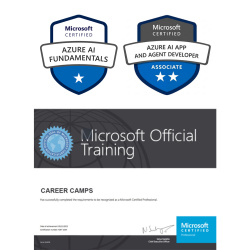
MCA Azure AI App & Agent Developer Associate Certification (AI-901, AI-103) Boot Camp
Price range: $3,495.00 through $4,495.00 Course Details This product has multiple variants. The options may be chosen on the product page -

Generative AI Strategies for Project Managers Training Class
$2,050.00 Course Details This product has multiple variants. The options may be chosen on the product page -
Building Practical Skills in NLP and Generative AI Training Class
$2,785.00 Course Details This product has multiple variants. The options may be chosen on the product page -
Applied AI for Government IT Professionals Training Class
$2,785.00 Course Details This product has multiple variants. The options may be chosen on the product page
Ready to Take the Next Step?
Choose your upcoming training date or talk with our training advisors about the right option for you or your team.